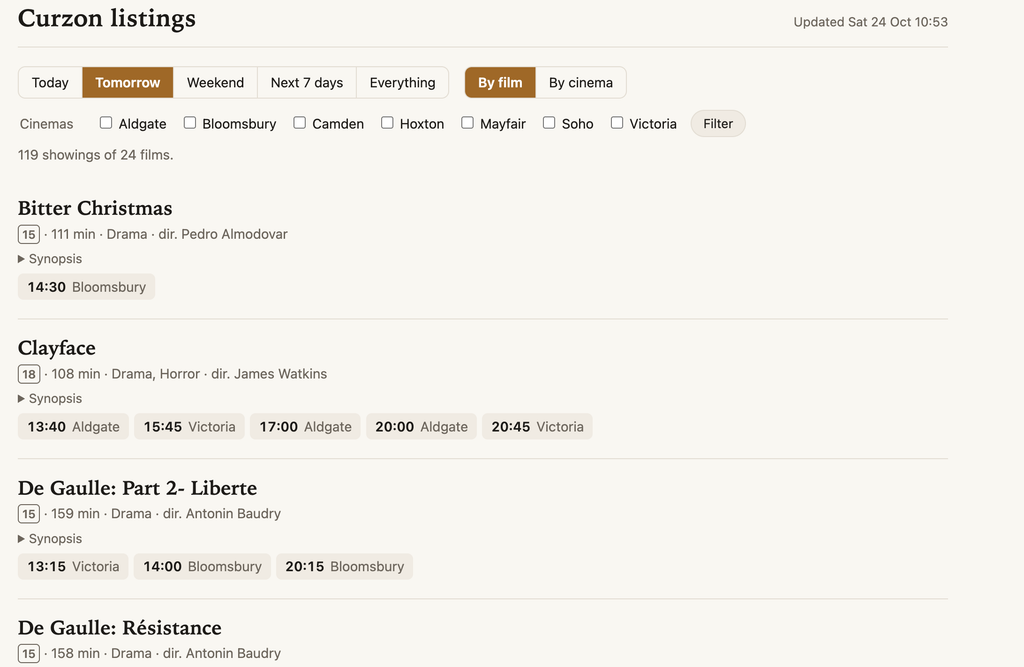
A year ago I used AI to help me build a website that showed cinema listings out of frustration with cinema websites.
(Seriously, what is up with cinema websites? I just want to know what films are on on a given day in cinemas I can reasonably get to. Instead I have to decide either which film I want to see first, or what cinema I want to go to, meaning I have to navigate about 80 pages before I have the information I want. And then I forget what showings I had seen two minutes ago.)
My AI-assisted build was ugly and clunky (it was a hook that triggered a shell script that got the data from the site and put it in a temporary sqlite db, then plain-text output it to the HTTP response – yes, I am that old). But it kinda did the job. After a while it got subject to bit rot, stopped scraping successfully, and I stopped using it and forgot about it.
Tonight I resuscitated it and one-shotted a professional-looking but simple site that still gives me the information I wanted (and more – it added useful stuff like plot synopses and ratings) in 5 minutes. It works perfectly, and I don’t even know what tech it used.
Nothing new in that – one-shotting a useful site now feels old hat now that we’re firing a large chunk of employees because AI.
What it make me think was that everything is an API now.
I don’t need to interact with that annoying cinema site anymore (except to buy tickets, though it’s tempting to automate that as well…). I can just point my harness of choice at it and tell it to give me the interface I prefer.
Everything is an API now. Think of that, and what it means for a software engineer now!
If you feel this was useful, consider buying me a coffee to say thanks!
For twenty years, saying “don’t reinvent the wheel” was usually enough to win any argument about writing bespoke software. But that advice assumed two things: writing code was expensive, and importing code was cheap. AI and supply-chain governance are changing both assumptions.
A Short Personal History of Libraries
When I started in software it felt like the wild west in terms of security, audit and compliance. I worked in an unregulated industry as a third party supplier to some FTSE-100 businesses as an engineer. I could tell stories about access and identity management (or the lack of it) that would turn a 2026 CISO’s hair white (or, more likely, whiter).
Wind forward a quarter of a century, and now security is not only its own discipline, but (mostly) fully baked into the software development lifecycle. Compliance is on its way to the party too (this is the area I’m working on at the moment, contact me etc.).
In parallel, software libraries have also become more and more embedded into the software development lifecycle. It may be hard for younger readers to believe, but I spent many years maintaining incredibly busy software platforms that rarely added a publicly available library to its codebase. If we did add them, they were mostly small enough that we could (and usually did) inspect the code ourselves.
These days, it’s not a software project unless you have thousands of npm dependencies you have never even heard of downloaded on an npm install, and my go.mod files can be even longer than the source code for some of my smaller or half-started projects.
The Software Library Pact
Outsourcing engineering to third party libraries always was a trade-off. Writing software was expensive and dangerous. It was far better to outsource bits of that to a freely available online solution. This resulted in a Faustian pact: add all these barely understood dependencies and you won’t need to find the money to finish your project. Aside from the financial benefit, you would get free upgrades, extra functionality you might need in the future, and so on.
This pact was popularised with the slogan ‘do not re-invent the wheel’, which is ancient wisdom to guard against the well-known tendency for engineers to build things unnecessarily to satisfy their creative urges.
However, the consequences of that (perfectly rational) pact are catching up with the industry. Mephistopheles has arrived to take his due, and now engineers’ dependency additions are now continually scanned and analysed for weaknesses by black hat crackers, white hat hackers, supply chain crypto thieves, and auditors alike. When a widely used library has a flaw discovered in it, millions of voices suddenly cry out in terror and are immediately busy managing patches.
It was while talking about these challenges of onerous library management recently with a friend that a thought clarified for both of us that had been circling our consciousness since the advent of LLMs:
Is it now sometimes safer and cheaper to write and maintain bespoke code, rather than importing libraries?
I know this sounds crazy, but let me explain. My friend works in the defence industry. Every new library involves an immense amount of bureaucracy to justify its addition, map its dependencies etc.. Then, once the library is embedded in the codebase, chances are high that flaws will be found in it (or one of its dependencies) that will incur significant bureaucratic costs to upgrade. Think of it like a dependabot workflow, but each alert is a punch in the face.
By contrast, application code that is peculiar to the code requires much less bureaucracy to implement and maintain.
Given that application-specific code is now very significantly cheaper to produce than it has been in the past, and using libraries is now more expensive than it has been in the past, then the calculus behind software delivery has been radically altered. Is it now sometimes safer and cheaper to write and maintain bespoke code, rather than importing libraries? The specific example my friend adduced was a large open source library, a small subset of which’s functionality he wanted to use. He ended up reimplementing that small piece with an LLM, as he reasoned that in that case the various trade-offs were worth it.
I mentioned this notion to an experienced CISO recently and it’s fair to say he was not amenable to the idea. I won’t retail his exact words, as I know some readers have delicate sensibilities.
The CISO objection is not stupid. The industry has learned the hard way that bespoke code is often unreviewed, under-tested, undocumented, and full of boring vulnerabilities. “We wrote it ourselves” is not a security argument.
I’m not giving up on the argument that the calculus has changed though, because I think there’s an economic case to be made in an increasing number of cases. The old mental model was that “npm install is free!”, whereas the new model is that every dependency is a recurring obligation. Each library creates future work: CVE triage, version bumps, breaking changes, SBOM entries, licence checks, audit queries, exception handling, patch windows, and operational risk.
Benefits
Let’s itemize the benefits of choosing to build your own functionality than import dependencies:
1) Writing Code Is Cheaper Than It Was
LLMs can spew out functionality all day, and they’re far, far better at that than maintaining and reasoning about larger systems. You still have to make sure the code it produces works as intended, write tests (LLMs can help with that too), etc., but it’s undeniably cheaper to write an internal library to (for example) prepend characters to a string than it was pre-LLM.
2) It’s Private
Your internal library does not get picked up by code scanners (unless they can comb through your source code directly, in which case they are welcome to find fault). Your internal library does not need to be put in an SBOM. This will reduce noise right across your SDLC.
In other words, bespoke code removes one class of externally visible dependency risk: maintainer compromise, dependency confusion, abandoned packages, and surprise transitive upgrades. It does not remove the need to scan, test, review, and threat-model the code itself.
3) It’s Crafted for Purpose
Code that you make for your needs does exactly what you need it to, and no more.
It’s not subject to any particular library’s bloated attack surface now, or in the future. It doesn’t pick up an increasing number of secondary dependencies over time as it tries to cover more and more features and corner cases you don’t have.
4) It’s Cheaper to Maintain / More Secure
We’ve already discussed some of the ways it can be easier to maintain, but it’s worth itemising the kinds of attacks and disruption that we’ve seen due to third party dependencies:
left-pad (2016), where the withdrawal of 11 lines of non-obfuscated code introduced as a library dependency resulted in widespread panic
event-stream (2018), where another widely-used package was used as part of a supply chain attack that tried to steal Bitcoin wallets
faker.js (2022), where the maintainer decided to ‘upgrade’ his code to a cris de coeur about the ingratitude of the industry towards open source maintainers
The failure modes are not “the library has a bug.” They are: the maintainer disappears, the maintainer is compromised, the maintainer turns hostile, a transitive dependency changes, a package is unpublished, or the ecosystem shifts under you.
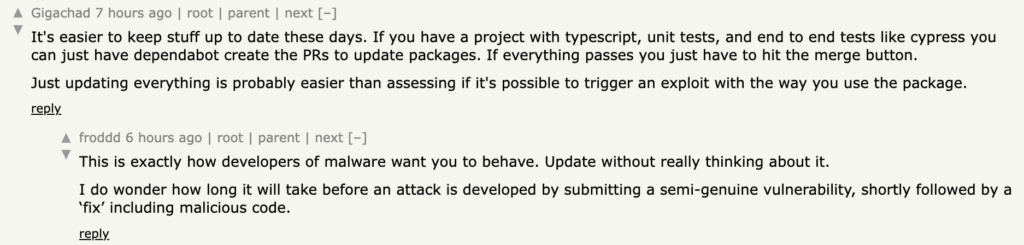
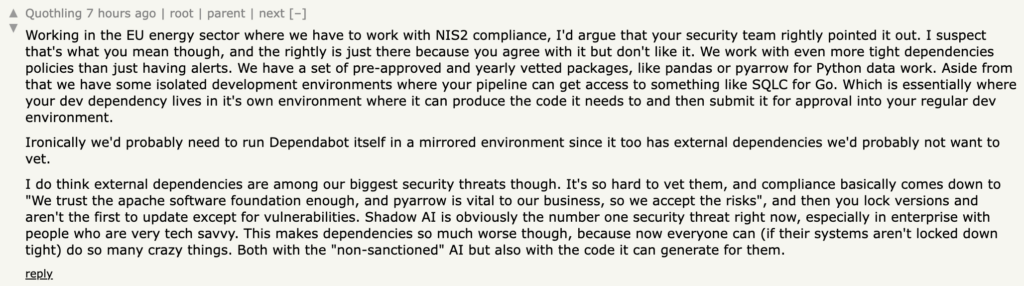
A recent discussion about vulnerability management on HN has some good illustrations of the tensions.
I could also bring in arguments about security through obscurity being a useful (but obviously not sufficient) line of defence, but the itself phrase seems to trigger people, so I won’t.
Objections
The question is not whether we should stop using libraries. The question is whether some dependency imports are now harder to justify than bespoke, narrowly scoped code.
But since what I’m talking about is a trade-off there are of course reasonable objections to raise. I’ll itemise them here, and argue how these arguments’ force has changed recently.
1) It Will Be Less Secure
Your code is specific to you, and hasn’t been subject to a ‘many eyes make bugs shallow’ process of open source delivery. Your code might have old-fashioned flaws like unchecked input, for example.
These objections are self-evidently true. However:
LLMs (and other modern tooling) can perform a lot of the security checking of code locally, and far more cheaply than a traditional sec team.
Libraries (as we’ve seen above) have attack vectors that make them less secure also.
2) It Will Be Harder to Maintain
I don’t think that will always be true now that we have some form of intelligence to scour our code. Further evidence for how it is hard to maintain libraries is outlined above.
If your code talks to a well-known API for example), then you could argue that using a public library will make you more future proof. Whether that argument holds will depend on how often and significantly the API changes, how much of the API you need to interact with, and how likely it is that the library will be well-maintained in future. I’ve spent a fair amount of time in the last 10 years chasing down poorly maintained libraries that haven’t kept pace with their target API, resulting in me spending significant effort replacing one library with another (or even, not infrequently, having to patch the library with some code I write myself as no such library now exists).
3) If Your Engineers (Now Or In The Future) Are Clueless, This Could Be A Disaster for You
Absolutely.
4) Some Libraries Are Too Important To Rewrite Yourself
Yup. I definitely don’t recommend rolling your own cryptographic libraries, or implementing your own timezone management functionality.
LLMs do not make writing hard software easy. It makes some boring ‘already solved’ software cheap enough that importing a dependency is no longer obviously the cheapest option.
Towards a Decision Framework
Here I propose a quick checklist of things to consider when deciding which way to go. You might want to score each one and to see which way you want to go.
Points for the library:
The domain is security-sensitive, complicated or difficult to correctly code
The library is mature and widely reviewed
The library is well-supported and likely to be maintained for a long time
The library has few transitive dependencies (and those dependencies are themselves solid projects)
Consider writing your own when:
You only need a small subset of a large library
The libraries’ used functions are simple and easily specified
The dependency brings many transitive dependencies
Approval and vulnerability-management costs are high
The code can be exhaustively tested by code you can maintain
The blast radius is low
If you feel this was useful, consider buying me a coffee to say thanks!
This post (Part I) walks you through a Git repo I put together to allow anyone to fine-tune a model to write emails in their own ‘voice’.
I did this to use a small model that I could run at home to help me draft emails that didn’t suck.
You don’t need a hefty GPU, but you will need a credit card to rent one on vast.ai for the training (note: affiliate link – I will benefit if you sign up and spend). It costs me about $1 per run to create a useful model that I can use on my home (non-GPU) server.
Part II will dive deeper into how the script works and what’s going on.
What It Does
At the very highest level, the script creates a new large language model (LLM), building from a base model, and training on sample emails you give it. Here’s some sample output (truncated to 40 tokens):
INPUT:
Write an email to a friend arranging a drink:
OUTPUT:
Hey, how are you? I was thinking of going out for a drink this evening. Are you free? Let me know what time and where we could meet.
Ian
On 10 Jul
You can see how it’s put my name (Ian) at the bottom and a (spurious) date, because that’s why a typical email looks like from me.
Compare this to the ‘base’ model this was built from (Qwen/Qwen2.5-3B-Instruct), which gives a far more ‘generic’ and formal response (also truncated to 40 tokens):
INPUT:
Write an email to a friend arranging a drink:
OUTPUT:
The date is 10/24/10  at 6:00pm.
Subject: Exciting Plans for Our Drink Date!

Dear [Friend's Name],

I hope
That, by contrast, does not sound like me at all.
…in a bit more detail
Here’s what the script (run_fine_tune.sh) does:
Picks the cheapest available GPU from vast.ai that fits the criteria needed, and provisions it
Copies up a script to run on the machine (build_and_push_model.sh), the gmail samples you want to train it on (compressed), and a huggingface token (to store the resulting models)
Runs build_and_push_model.sh on the GPU, which:
Installs the needed software (LLaMA-Factory, llama.cpp)
Logs into huggingface
Creates the huggingface repos (if needed)
Trains the new model
Merges the new model
Converts the new model to .gguf format (allowing it to be run in llama.cpp)
Quantizes the new model (so it can be run more easily on a non-GPU machine)
Pushes the merged model, and the .gguf, to huggingface repos
Use Google Takeout to download your sent email to a .mbox file. You probably only need your ‘Sent’ emails, as they contain your responses. If you don’t use gmail, the script expects a .mbox file. Then run the python script to extract the emails and put them in the correct format. Then compress the result with xz
The book’s primary goal is to help those engineers and managers whose efforts to change their organisations with technology hit the buffers as they scale. The direct application of sweat and resultant problem-solving worked well when you’re a more junior engineer, but as you try to make more fundamental and wide-ranging change seems to work less and less effectively. This book is intended to cast light on the invisible barriers that block your progress, and give you the tools to understand how to change them.
Its secondary goal is to be a more practical guide to making change within technical organisations, and even across wider businesses. While many books and blog posts exist on what the ideal state of various aspects of your organisation (culture, team structure, test practices, platform technologies etc) not enough of them give practical advice on how to get there, which is a far messier process. It might even help your career by allowing you to see how why – and just how challenging – it will be to get there, and perhaps consider setting yourself up for success elsewhere.
I hope the book will distil the experiences I’ve had over the past five years as a Could Native consultant with Container Solutions, and the last 30 years as an engineer, to give the reader a head start in navigating these murky waters.
The book will be replete with practical advice and real-world case studies to illustrate and provide inspiration (and caution) about what lies ahead for those that want to make positive change.
I hope you’ll join me on this journey. If these themes resonate, stay tuned. I’ll be sharing updates, excerpts, and insights here along the way. In the meantime, this video (‘How Money Flows Trump Conway’s Law) shares some of my more embryonic thoughts from a couple of years ago.
Your thoughts, questions, and experiences are always welcome!
Writing A 1996 Essay Again in 2023, This Time With Lots More Transistors
ChatGPT 3
Gathering the Sources
PrivateGPT
Ollama (and Llama2:70b)
Hallucinations
What I Learned
TL;DR
I used private and public LLMs to answer an undergraduate essay question I spent a week working on nearly 30 years ago, in an effort to see how the experience would have changed in that time. There were two rules:
No peeking at the original essay, and
No reading any of the suggested material, except to find references.
The experience turned out to be radically different with AI assistance in some ways, and similar in others.
Although I work in software now, there was a time when I wanted to be a journalist. To that end I did a degree in History at Oxford. Going up in 1994, I entered an academic world before mobile phones, and with an Internet that was so nascent that the ‘computer room’ was still fighting for space with the snooker table for space next to the library (the snooker table was ejected a few years later, sadly). We didn’t even have phones in our dorms: you had to communicate with fellow students either in person, or via an internal ‘pigeon post’ system.
My typical week then was probably similar to a week of a History student in 1964: tutorials were generally on Friday, where I would be given the essay question and reading list for the following week:
A typical History essay reading list from 1996. My annotations at the top related to the library reference details, and the notes at the bottom (barely legible even to me now) I suspect were the notes I made during the hour as my tutor was telling me what I should have written about.
That afternoon I would go to several libraries, hoping that other students studying the same module hadn’t borrowed the books on the list. Over the following week I would try to read and make notes on the material as much as possible given my busy schedule of drinking incredibly cheap and nasty red wine, feeling depressed, and suffering from the endless colds living in Oxford (which is built on a bog) gifts you free of charge.
The actual writing of the essay would take place on the day before delivery, and involve a lot of procrastination (solitaire and minesweeper on my Compaq laptop, as I recall) while the painful process of squeezing the juices from my notes took place.
I didn’t go to lectures. They were way too early in the afternoon for me to get out of bed for.
Writing A 1996 Essay Again in 2023, This Time With Lots More Transistors
The essay question I chose to answer was from a General British History (19th-20th century) course:
How far was the New Liberalism a Departure from the Old?
ChatGPT 3
I first went to ChatGPT (3, the free version – I’m a poor student after all) to try and familiarise myself with the topic:
Already I was way ahead of my younger self. I had an idea of what the broad strokes I needed to hit were to get a passable essay together. ChatGPT is great for this kind of surveying or summarizing stuff, but is pretty bad at writing an undergraduate-level essay for you. It can write a passable essay (literally), but it will be very obvious it was written by an LLM, and probably at best get you a 2:2 or a third, due to the broad-brush tone and supine mealy-mouthed ‘judgements’ which contain very little content.
After a few more interactions with ChatGPT over the next few minutes:
I was now ready to gather the information I needed to write the essay.
Gathering the Sources
The first step was to get the materials. It took me a couple of hours to find all the texts (through various, uh, avenues) and process them into plain text. I couldn’t get the journal articles (they were academically paywalled), which was a shame, as they tended to be the best source of figuring out what academic debate was behind the question.
Those couple of hours would have been reduced significantly for any future essay I might choose to write, as I spent some time figuring out exactly where to get them and installing software to extract the plain text. So I would now allocate an hour to getting the vast majority of texts, as opposed to the small subset of texts I would hunt down over a significantly longer time in the physical libraries 30 years ago.
PrivateGPT
One of the well-known limitations with ChatGPT is that it doesn’t tell you what the relevant sources are that it looked at to generate the text it gives you.
I found out that this repo gives us a quick way to augment an LLM with a set of documents, so I installed it on an old Dell Xeon desktop with 24 cores and 128G of RAM. This machine cost me about £600 a couple of years ago, and still works a treat (I bought it to run Kubernetes clusters). It doesn’t have a graphics card in it, so I thought it would be usable for this kind of work, but it’s just fine with ‘normal’ CPUs (as long as you don’t demand instant responses).
$ python3 ingest.py
Appending to existing vectorstore at db
Using embedded DuckDB with persistence: data will be stored in: db
Loading documents from source_documents
Loading new documents: 100%|███████████████████| 12/12 [00:00<00:00, 274.84it/s]
Loaded 12 new documents from source_documents
Split into 38046 chunks of text (max. 350 tokens each)
Creating embeddings. May take some minutes…
Ingestion complete! You can now run privateGPT.py to query your documents
Ingestion of the 10M sources took about five minutes. I asked it a few questions, and this was a typical output:
> Question:
what was the changing role of the state in new versus old liberalism

> Answer (took 169.94 s.):
 The main difference between "new" and "old" liberalism lies in their approach towards the role of the government within society. While traditional or 'Old' liberals believed that minimizing intervention by the State would lead to a more prosperous economy, ‘New’ Liberals acknowledged the need for state action and social reform as necessary measures against industrial poverty. In essence, new liberalism marked an evolution of thought among liberals towards greater acceptance of government responsibility in promoting general welfare through interventionist policies.

> source_documents/the_age_of_lloyd_george_kenneth_o_morgan.txt:
It was, therefore, the Old Liberalism which helped to repair the fortunes of the party—nonconformity and industrial free trade, the very essence of the Liberal
faith for half a century. Where, however, was the ‘New Liberalism’ which could embrace a more positive attitude towards the central government, for which many

> source_documents/the_new_liberalism_weiler.txt:
In the broadest sense, the term new Liberalism refers both to the welfare legislation of the 1906-14 administration and to the changes in Liberal social and
political theory. At the time, however, the term first referred to the theoretical changes which preceded the legislative achievements of the Liberal government.

> source_documents/the_new_liberalism_weiler.txt:
What then was the new Liberalism? As defined here, it was the modification of Liberal ideology from a vehicle for a mid-Victorian ideal of laissez-faire to a
philosophy based on state action and social reform to cope with industrial poverty. This modification was achieved by Liberal journalists and theorists seeking to

> source_documents/the_new_liberalism_weiler.txt:
state, a development that represents the fruition of the new Liberalism.

New Liberalism
The Political Economy
of J.A. Hobson

UNIVERSITY OF TORONTO PRESS
Toronto Buffalo London

Toronto Buffalo London
Printed in Canada
ISBN 0-8020-5558-3

> source_documents/the_new_liberalism_weiler.txt:
understanding of the phenomenon of the new Liberalism itself.

> source_documents/the_new_liberalism_freeden.txt:
THE SOCIAL POLICY OL THE NEW LIBERALISM
You can see that the output is mixed in quality (the model I used was relatively small, see Ollama section below), but it did point me at potentially relevant sources for quotes and bits to read. I spent about another hour rooting around these texts and gathering bits of text that I might use later. Note the response time, however (about three minutes is typical). I got a bit frustrated with the response time vs quality and went looking for other tech to use.
Ollama (and Llama2:70b)
This was the combination of technology that blew my mind. It absolutely changes the game for this kind of work. Ollama is a project designed to ‘get up and running with large language models locally’ which borrows concepts from Docker (like the Modelfile (similar to the Dockerfile, and ollama get/pull/list)
Compared to the ChatGPT output, Llama2:70b (with a Llama2 model with 70b parameters) allowed me to automate a significant chunk of the work needed to write the essay, reducing the time needed to write the essay from days to less than a day.
I downloaded the biggest model I could find (Llama2:70b) and asked it the question in a very unspecific way. It returned a much better essay plan than ChatGPT did:
At this point I started writing the body of the essay (introductions and conclusions are best left to the end), basing each paragraph on the numbered points above. As I wrote, looked at specific texts to find references and asked LLMs questions, something unexpected happened: I was learning about the nuances of the debate (mainly through looking the Collini book I hadn’t been able to find in the 90s).
I was getting sucked into a temptation to actually read the texts, and had to remind myself that I wasn’t allowed to do that, according to the rules of the ‘game’ I was playing here.
This appreciation of which texts were important, and what I was being invited to write about happened much faster than would have been the case pre-Internet. I really do wonder how students do this today (get in touch if you can tell me!).
Hallucinations
A well-known limitation of LLMs is their tendency to ‘hallucinate’, or ‘bullshit’ a plausible-seeming answer. I definitely saw this, and it wasted some time for me. Llama2 gave me this nice quote, which raised suspicions with me as it seemed too good to be true:
Evidence: In his book "Industrial Democracy" (1902), Webb argues that collective ownership and control of the means of production is necessary to address the systemic issues that perpetuate poverty and inequality. He writes, "The only way to secure industrial democracy is through the collective ownership and control of the means of production."
But I couldn’t find that quote anywhere in the book. Llama2 just made it up.
What I Learned
After writing my AI-assisted essay, I took a look at my original essay from 1996. To my surprise, the older one was far longer than I remembered essays being (about 2500 words to my AI-assisted one’s 1300), and was, it seemed to me, much higher quality than my AI-assisted one. It may have been longer because it was written in my final year, where I was probably at the peak of my essay-writing skills.
It took me about six hours of work (spread over 4 days) to write the AI-assisted essay. The original essay would have taken me a whole week, but the actual number of hours spent actively researching and writing it would have been at minimum 20, and at most 30 hours.
I believe I could have easily doubled the length of my essay to match my old one without reducing the quality of its content. But without actually reading the texts I don’t think I would have improved from there.
I learned that:
There’s still no substitute for hard study. My self-imposed rule that I couldn’t read the texts limited the quality to a certain point that couldn’t be made up for with AI.
History students using AI should be much more productive than they were in my day! I wonder whether essays are far longer now than they used to be.
Private LLMs (I used llama2:70b) can be way more useful than ChatGPT3.5 for this type of work, not only in the quality of generated response, but also the capability to identify relevant passages of text.
I might have reduced the time significantly with some more work to combine the llama2:70b model with the reference-generating code I had. More research is needed here.
Hope you enjoyed my trip down memory lane. The world of humanities study is not one I’m in any more, but it must be being changed radically by LLMs, just as it must have been by the internet. If you’re in that world now, and want to update me on how you’re using AI, get in touch.
The git repo with essay and various interactions with LLMs is here.